Sunday, 4 November 2012

House at the end of the Street - Trailer analysis 2


The opening title ‘FILMNATION ENTERTAINMENT’ employs an unusual horror convention by having the background a yellow/orange colour with the graphic design made to look as if it’s the sun’s beams. It quickly transitions to a more typical or more expected opening title ‘momentum pictures..’ the text itself still resembles the sun, as its bright and almost a yellowish colour. The background however follows horror movie conventions as it is dark, with cracks and looks as if it has been worn away and is dated. The title appears to come out of the screen as if it is almost going to be a three dimensional movie, and just before it fades to the trailer, part of the text flashes as if it doesn’t work properly. This suggests to the audience that the clip is not working properly, but also makes the audience wonder if the evil creature is affecting the clip. The opening titles fade, which makes it a smooth transition and has a calming effect. The establishing shot is of a girl walking alone at night time in an isolated area, which suggests she is likely to be the victim as this is often the case in many horror movies. The surrounding area that she is walking through appears to be slightly run down and the older street lights imply that the area has not been modified or changed for a long period of time. The audience may question why the street lights have not been updated to a more modern standard. Later on in the trailer we can piece together that not many people want to live or enter this area through the mother telling the main character “you know that house is the reason we can afford to rent this house..” and the leading male character saying “the rumour is that you can see her in the woods”.
 
The establishing shot cuts to a shallow focus, a mid-close up of the girl- who is not dressed particularly conservatively- with the car in the background. The main character has long blonde hair and natural make-up, making her look quite innocent and connotes that she will probably be the victim in this movie. The car in the background is still out of focus and the audience cannot tell who is driving it, which adds an element of mystery and suspense. There is another cut to a long shot that includes the whole of the car and the girl walking besides it. This scene seems familiar as the audience assume she will be kidnapped or killed. The cuts keep a fast pace and ensure that the audience cannot get bored. The scene is cut to a black screen, which makes the audience wonder what happened to the girl, and as they cannot see anything it makes the trailer more frightening. The sound in the beginning is non-digetic and very subtle, we only hear white noise and a subtle eerie noise, allowing us to hear the digetic sound of the car pulling up more clearly. The non-digetic sound then culminates in a subtle stab as the screen fades to black. While the car is reversing, the audience realises that the driver is actually a young man- someone we assume is relatively safe and will not harm the girl. He politely offers her a “ride home” however she declines, we see this through the drivers point of view, with what the audience assumes to be part of his car partially blocking his view. It cuts to a black screen once again adding mystery to the scene, this then fades to the two people having a conversation. A close up shot of the man allows the audience to believe he is a ‘normal’ character and has nothing to hide. His costume- a light blue/grey t-shirt permits the audience to believe he is an innocent and ordinary young man.


The screen flashes black and white and then a long shot of a house is presented- connoting that the previous confusion (shown by the flashing black and white colours) is now relieved as a stable and common element for everyone- a house is now introduced, hinting that normality will proceed. This moves on to the mother and daughter talking about “that house”, which shakes the audiences beliefs up as they were led to believe normality was going to continue but are now suspicious of a neighbouring house. Shallow focus is used which makes the audience focus on just the mother and what she is saying. Also it makes the main actress seem as if her thoughts are pre-occupied or she is ‘not there’. The clip cuts to the girl looking out the window where a reflection of the forest can be seen- a typical horror movie setting. The scene fades to a sudden close up of a lamp being knocked over fills the screen. Usually when a lamp is knocked over it breaks and light no longer emits from it, this is not however the case in this trailer, it hints that there is something odd and abnormal in this house. The audience see a young girl walking past to the lamp, at first an audience member would be mistaken for thinking that the young girl may be sleep walking. The screen flashes and the lamp has gone, the girl seems to stagger and the lighting flashes on the set- while the lamp is suddenly standing upright again. A black screen is made use of which adds suspense and an element of surprise, this fades to an establishing shot of the next day.


A family appear to be having breakfast around a table together with a school, church or some older building in the background. The camera pans around the table in a circular motion, making everything seem normal but the speed of the pan implies that the girl is slightly panicking. This seemingly calm situation is disturbed by a bright light shining on the house, which is distorted by various shapes of light- this could possibly be the view of an animal or evil creature that is watching the house. An eye appears in the carnage for a brief moment and then the girl who knocked over the lamp appears on screen, she is holding what looks like a snow globe with the house in it. The snow globe as a prop contrasts with the young girls overall image as we associate such items as innocent and toys for children- not a prop in a horror movie. This is a convention of a lot of horror movies, taking innocent items or people and changing them into evil objects or characters. It is more shocking to see something innocent become something evil, as it goes against our expectations and is quite unsettling for the audience. The view inside the snow globe is initially distorted, which does not bode well and suggests that normality and life will become distorted. This could also be foreshadowing of the protagonist to be trapped within a distorted and scary world. The audience still hasn’t seen her face fully, so she is a frightening character- the technique of not showing who the killer or villain is a common feature in horror films as we cannot see what we should be afraid of we become un-necessarily afraid. A black screen is employed again, and then the camera has a bird’s eye view of a couple half asleep in bed, with lightning flashing into their room. A close up of the girl is appears on screen and then it cuts to a black screen again, implying that the girl is going to do something bad to the couple. The camera blinks and none of the shot is in focus, until we see a mid-close up of the man in bed, with a terrified and confused expression on his face.
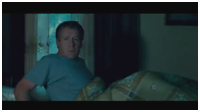


The next shot is under the bed, with a tint to the image on screen making it un-recognisable, the girl’s foot then comes off the bed, the floor covered with feathers- which suggests she has attacked or killed him. The feathers also suggest that someone has pulled apart her bed clothes and pillows, as they are often made using feathers, while she was asleep. This would suggest an unwelcome presence in the house. The shot of her feet coming off the bed, is jumpy and flashes a lot, which makes the audience more scared. The fast editing allows the audience to realise there was no time for the man to save himself from the girl, as she was too fast and strong for him to fight off. Or another possibility is that the girl was his daughter or someone he knew and trusted, so he was not prepared or ready to defend himself.


A newspaper clipping appears on screen, notifying the audience that it is probable that this was a real event that occurred in the past. This fades to a crime scene in a forest, with police tape- implying that the girl has continued to kill or attack people. A cut is used to go to a scene in the woods, which is in a worms eye position, intimating the fact that something or someone is hiding low in the ground, waiting to attack. There seems to be a ‘bubble’ effect on the camera, as the woods look distorted similar to the scenes of the distorted house and the snow globe. Thus linking all the shots together allowing the audience to know that these events are connected and not just random parts of a story.


The camera appears to be there for a long time, as the audience see the shadows move around the trees, hinting that a long period of time has passed and the murders were committed a long time ago. Or it could be representative of the creature hiding and waiting to attack someone for a long period of time- possibly connecting to the same reason why the street lights had not been updated. A jump cut is made use of as well as another tint to the camera, making it more frightening, the screen is black again and then fades to a shot of the mother and daughter from behind trees. This shot is frightening for the audience as they assume someone is stalking the mother and daughter. The girl suddenly turns around when her and her mother are approaching the house. An eyeline shot shows she is just looking at the forest and cannot see anything that poses a threat to her. The camera zooms in to the forest then cuts to behind the trees, where someone or something is watching her again. We see a figure, that we guess is a man, move to the right and causes the screen to go black again. As expected it fades to the girl, who is standing near the blinds and looks out of them, the audience then sees this from further away, and only sees the light of the window, which is a strange occurrence. The shot cuts to the mother and daughter talking again and then fades to a couple kissing on the couch, and the editing is jumpy again, showing the audiences that their pulses are racing and something life changing may happen soon.

 This leads on to another black screen which cuts to a strange scene of a girl coming out of the floor, like a monster or creature of sorts. The fact that she is seemingly rising out of the floor boards, makes her seem less human and more evil, especially as hell is known to be underground we assume she has arrived back at the house after leaving hell. The shot cuts back to a close up of the couple, then back to a black screen, then back to the girl coming out of the floor, this sequence is repeated- allowing the audience to take all of the information in, but also makes them question whether they saw the girl rise out of floor boards twice or once. A close up of the young girls legs walking up stairs, a cut to a black screen, and then a cut to a close up of a door handle moving up and down on seemingly on its own. The audience wonder if this young girl/creature is controlling the door handles movements, as a few moments ago she seemed human by walking past. This idea of evil lurking within us is a convention used in modern horror movies, as we are no longer afraid of vampires or werewolves, we are afraid of who we have become and the evil within.  The girl opens a door and walks in- this scene is jumpy as the girl appears to move speedily and then very slowly through the passage way. A cut to a black screen is unsurprisingly used, making the audience wonder what will happen next. Another cut is employed, and focussed onto a close up of the girl from the beginning of the trailer, she calls out ‘Ryan’ and slowly walking towards a door, until a black screen appears. This fades to the girl opening the door where the young ghostly girl was earlier. The camera rolls up the side of the main character’s back and then cuts to a close up of the girl covering her mouth, looking down in shock and whispering “oh my God”. The now ghostly young girl is watching the main character from behind a wall, the audience assume that the young girl has killed someone or somehow uncovered a secret that the main character has found. The audience are anxiously waiting for the horrific discovery to be unveiled, but keeping the suspense the camera does not pan down to reveal what it is.


A strap is then added to the trailer, the text reading ‘THIS YEAR’ is a bright orange colour which contrasts with the overall theme of the trailer. When the footage of the trailer is presented the sound is digetic sound but when the strap lines with the wall paper come onto screen the sound consists of short stabs of high piercing sound. The background appears to be old wall paper, with mud or blood splattered onto it. This strap fades and then the girl seems to be asleep having a night-mare, with profile lighting, and all you can see is her face. A cut to another strap, reads ‘FEAR WILL FIND’, again the text contrasts with the background as it is bright orange and the background is wallpaper and wall which has plaster falling off it and ripped off wall paper- which follows the conventional setting of a horror movie taking place in a haunted house.
A cut to a mid-close up on the mother on the phone, is used then the camera cuts and zooms into a picture of a man and a girl which is lying on the floor, the mother ends the call and a strap is employed again. ‘A NEW HOME’ again is the same as the two previous straps however the background is different as there seems to be strange markings on the wall which is white and not almost black and grey. Spiders or ash seem to be falling in all of the straps, which makes the audience think that the disastrous event will occur soon.


The Uninvited - Trailer analysis 1


The Uninvited

The trailer begins with a shot of the back of the actress' head and pans around as the conversation continues, this is the equilibrium stage. The clip then cuts to a candle in a glass lantern falling onto the ground and smashing the glass, then the shot cuts to a flashback of the main character looking in horror at the smashed lantern. Candles and fire are associated with horror movies, as the two objects are linked to religion, some horror movies employ religious artifacts or iconography to make the movie more frightening. Religion is traditionally what people turn to when in need or are fearful of a situation. However when religion is portrayed as the disequilibrium people become even more afraid as they have nothing to turn to.  Profile lighting is employed, the audience can only see half of her face. Leaving the other half to the imagination. The use of profile lighting also creates an eerie, unsettling feel from the off-set.

The audience later discover that the house has exploded and a sense of panic is instilled, and this panic is heightened when the screen cuts to a blackout. The audience will want to know what happened. It is assumed that the trailer will continue and reveal what has happened to the main character after the explosion/fire, however the clip fades back to the original setting of the girl talking to the man (psychologist/doctor). The camera shot is now over the shoulder of the patient, while she is speaking to the doctor; not seeing her face maintains the intrigue. Slight panic is created again when the scene is cut to the girl running down a corridor and bursting out of the doors. This moment is captured by a bird’s eye shot, which introduces the idea of her being free as she is now leaving the institution. This scene fades to an establishing shot of a car travelling on a road near a forest, this may reflect the idea of freedom and peace that the main character feels. However the bird's eye shot and surrounding forest is a classic and technical convention found in horrors. It is used to show that the character is entering into an environment that is isolated and in the middle of nowhere and therefore potentially dangerous. The main character is re-united with her sister and they embrace each other. Their close relationship is shown when they link fingers and jump into a lake together. This cheerful and freeing moment is captured again with a bird’s eye view shot- this could possibly be perceived as God watching over them and protecting them from evil, but also makes them seem small in relation to the environment surrounding them and therefore vulnerable. When the two girls land in the water, the screen fades to black which suddenly implies that a bad event will occur, however this is not the case as soon after we see the two girls shortly afterwards.

However the mood changes when a point of view shot is employed and we see the two sisters looking at their new step mother, the audience get the impression that she is the antagonist. The step mother appears to be applying lotion onto her legs and is dressed very revealingly- as a lot of female characters in horror movies usually are. The screen fades to a black screen again, which might suggest that something negative or disequilibrium is going to occur soon. It fades back to an establishing shot of a house next to a river, then cuts to the main character and the step mother having a conversation. The location is ideal for a peaceful scene and an over the shoulder shot is used again to try and give the audience an insight into their relationship and provide a sense of normality. The older woman is dressed similarly to the two teenage sisters and the elder sister gives (her sister) the main character a look of complete annoyance and disrespect towards their step mother. The screen fades to black one again, but quickly fades back to a shot of the main character sitting on the grass. The fast editing allows the audience to presume that the main character hasn’t been affected or dwelled on the conversation with her step mother. She is surrounded by long grass and various foliage, birds are also seen flying in the distance this scene appears to be calm and peaceful. The audience assume that she is trying to get away from the step mother and once again have a sense of freedom. Having the main character Anna, sitting in this  environment helps us see her as less of a threat and a peaceful character. Her father standing next to her tries to comfort her, but a close up of her playing with a piece of grass, shows her disinterest in him and what he has to say.

A blackout fades to the step mother and father on a couch together, with the father suggestively stroking the woman’s shoulder, the couple look content, however the step mother glances over to the camera and gives an assertive and confident look- which the audience would assume a victorious scowl to her step daughters. This action supports the earlier prediction that she would be the antagonist.

The sisters are found talking on a pier, with their feet in the water, which we would assume to be a peaceful and tranquil situation once again. This theory is proved wrong as after a quick cut the camera is in a dark passage and zooming towards a door, which shadows can be seen moving around on the floor, the camera rolls upwards and reveals a close up of the girls face. Profile lighting is employed again which adds a sense of mystery and highlights that she is hiding and doesn’t want to be seen. Darkness surrounding the main character could act as a symbol or represent all the darkness and evil that is surrounding her in her everyday life. Her left eye is lit up by the light coming through the key hole and the scene cuts to the step mother and who we presume to be the father being affectionate to each other. A glass ball or bead falls and a piece of it chips off- this may be representative of a part of the goodness in her life- her father- being unimportant to her after the incident she has witnessed. A graphic match is made use of and we see a close up of the girl’s eye. The light fades away to the centre of her eye, so only the black part and colour can been seen.

The black screen fades to an over the shoulder shot of the step mother and main character at a café or restaurant. The step mother is well dressed, wearing pearls, and manicured hair, which implies that she is the perfect house wife or trophy wife. The camera cuts to the main character, whose hair is messier, barely wearing any make-up and dressed much more conservatively. Her youthfulness is highlighted as she is drinking a large glass of coke compared to her step-mother who appears more sophisticated and is drinking tea or coffee from a porcelain cup/mug. The sophistication and apparent maturity of the step mother may aid her in her role as the antagonist as she is likely to be highly skillful and manipulating.

The next significant moment is when the camera uses shallow focused and zoomed in on the main characters face, and then it cuts to the step mothers face that is glaring at the main character. As the step mother leans forward to put a rose down on the coffin, the image is distorted and the screen is tinted green. The audience then see a little girl dressed in an old fashioned dress and shirt, staring accusingly at the main character. A close up of the little girl frightens the main character as we see a close up of her face, and eyes widening. The little girl walks in-between various people at the funeral and no-one else seems to notice her, it’s as if she is a ghost which adds to the mystery and suspense.

The odd event or experience soon ends as we see the main character awake from a dream, sit up and visibly sigh from relief. The camera hastily zooms away from her face to reveal more of her bedroom- which has a lot of shadows around it- making the room seem older and scarier. The audience assume that there may be something hiding within the shadows and sense danger. The screen fades to black , and then cuts to a strap stating ‘from the producers of ‘The Ring’ and ‘Disturbia’’. This allows the audience to have knowledge of previous films that the producers worked on and higher their expectations, making them want to see the film. Referring to 'The Ring' etc. gives an indication of the type of film it is, which will help to draw in the correct audience. The background is of moving fog or clouds, the edges of the screen are darker and appear to be storm clouds. Storm clouds possibly foreshadow a negative event occurring in the future and the centre of the screen is bright white which makes the strap more eye catching. The idea of not being able to see through the fog or clouds is a convention in horror movies, as many people are afraid of what they cannot see. The use of fog is common among many older horror movies and fog is associated with cold and fear- the audience of horror movies should be fearful.

A high angle camera shot is employed and is as if God or a higher power is looking over the main character, who is looking at a grave, with her hands placed gently either side of a headstone. The scene is tinted to a grey/green colour which is common convention and found in many horror movies. This tint to the clip makes the clip more realistic but aged and more believable. The graveyard itself is a frightening setting, but as the large headstone flashes, it adds even more terror to the scene. The little girl from the funeral earlier appears and looks over her shoulder towards the main character, who in turn just stares back at her in wonder and hopelessness, the camera pans around her and uses shallow focus, focusing on her face, the trees in the background seem to blend together and imply that the character is lost in her thoughts and possibly lost at the location she is at. The camera cuts to a low angle shot, it looks as if the camera is capturing this footage secretly and trying to blend in with the grass. A headstone is in the frame as well as trees surrounding the area, the ‘ghostly girl’, still dressed in the same costume is facing away from the camera, while two boys dressed in similar old clothing stand either side of her facing the camera. Their faces seem ghostly even though we do not get a close up shot of them. The two boys standing silently waiting for the ‘ghostly girl’ to reach them is a contrasting occurrence to what young two boys in today’s normal society would do- they would be expected to be running around playing and a mess- not smartly dressed and waiting obediently. The forest setting is also ‘spooky’ as light is only reaching the middle section, where the characters are standing, which would usually suggest that they are good characters that they are pure or holy and God is protecting them.

The scene fades to black and then to two men having a conversation- as if the previous scene with the little girl and two boys was just a dream. The camera cuts to a close up of the word ‘murders’ being typed on a computer screen and then zooms out to allow the audience to recognise the two sisters sitting at a computer. The setting is an office, which is dark implying that they are not meant to be in there. The blinds let through small slits of light but can also be interpreted as bars, and that the sisters are possibly trapped. A close up of the main characters face is used and her facial expressions notify the audience that she is indeed worried. The camera then focuses onto the computer screen and we see the ‘ghostly’ girl from the funeral and forest along with the two little boys- in a family photograph with their parents. The camera cuts to a syringe, which looks rusted and archaic and is possibly part of a crime scene or investigation. The camera is zoomed in on the little girl in the photograph, but the suddenly cuts to an image of the little girl in what appears to be prison uniform, and cuts quickly to the head line of a news paper ‘Murdered’, then to a knife in the same condition as the syringe. The audience had previously assumed that the little girl and her two brothers got murdered but a clip of the girl leading the two brothers away in a grave yard and the image of her in what we assume is a prison uniform- make the audience think she killed her two brothers.

The next scene is of the step mother of the main character, standing outside looking into the dark. The camera is at a low angle again looking upwards to her, making her seem more dominant and powerful. The assumed powerfulness and authority of the step-mother is proved by a shot of the two sisters looking out of a window at her in fear. A black screen is employed which suggests that something bad happened to the two sisters, however the audience are not sure if it is the step mother who has done or will do something bad and evil, or if it will be the ‘ghostly’ girl.

The fear seems to disappear when a man talks to the main character, but arises again after the screen goes black again. The audience then witness what would be a loving gesture to most- the step mother putting a necklace on the main character- however the facial expression of the main character Anna, tells the audience that she is not happy to be in this situation. The screen fades to black and the camera then cuts to the pearl necklace being placed around the Anna's neck, and the step mother pulling them unnecessarily tight and warning her step daughter to be on her best behaviour. The action of pulling the necklace around the neck suggests violence and allows the audience to see the stepmother as murderous. The screen fades to black once again adding further suspense and then a long shot of the main character is used. A plastic bin bag moves and the audience fear for the worst, that something is in the bag and will attack her, she seems to fear the same thing and a close up of her worried face is used. She goes over to the bag showing her braveness, and then looks under a table, a sequence of black screen then action, black screen then action is employed and frightens the audience as they want to know what is happening but can’t see anything. Before a hand full of mud and dirt grabs her arm there is a black screen which adds an element of surprise as most people would predict another small action then a black screen etc.


The girl fights off the being and rushes towards a table, knocking food off, in the actual film we see the stepmother coming in shortly after and complaining that she ruined the food on purpose. However next in the trailer sequence is a shallow focus on bruises and ‘battle’ scars on the girls arms. The screen flashes a white colour to make the bruises more stand out more. Shortly after we see a knife being pulled out of a knife ‘container’ and then a close up of a syringe, and a sudden flash of light, this sequence is similar to the sequence of the report of the little ‘ghostly’ girls murders. The cuts are fast which might mimic the audience’s heart beat as they are becoming increasingly more frightened. A woman jumps out in front of a car, and then a sort of graphic match is used and the main character then appears on screen also screaming. A close up of a tap fills the screen, with one drop coming out of the tap slowly the screen fades to black making the audience wonder what is going to happen, it then fades back to the main character in a bath, almost fully submerged. The water is almost grey which relates back to the strap with the clouds or fog- which could be representing the ambiguity that the main character has. The idea of being lost and not knowing what to do can be mentioned, as the main character no longer feels safe in her environment. The relation to fog is reinforced as a strap reading ‘SOME SECRETS’ with the foggy or cloudy background, this is almost an insight into what the main characters mind is like, unclear and foggy, lost and feeling hopeless. After the strap the audience see the step mother knowingly looking into a mirror which implies she has a secret, this is confirmed as the clip cuts to a close up of a person’s feet and a knife full of blood falling to the ground. This may suggest that the step mother is going to kill her step daughters and hints that she might’ve been the cause of her new husband’s death.

Another notion of what the ‘secret’ is, is introduced shortly after where we see the main character in a room and creature or what seems to be a disfigured human slowly approach her. The fast pace and panic is reinforced again by the strap ‘JUST WON’T DIE’, the text itself is large and then goes smaller to a normal size, this odd feature of the strap appearing to have a mind of its own and moving to its own accord is not a usual convention in horror movies. The creature or human from before presented again, crawling or hunched over and standing when the lightning effect takes place the human stands up, as if it has been given some power from the burst of light, and ‘just won’t die’ as the strap suggests. The audience can see that it is more human than creature, however being surrounded by darkness implies it is a human type creature who will not do any good, and will probably terrorise the main character.

The shot with the glass of  milk dropping before the milk turns into something thick and black is interesting, as it suggests purity and innocence being transformed into something sinister, dark, ugly and  un-defeatable. Milk is seen as a beverage for young children as it is nutritious and comforting. Anna the main character appears to have had a difficult transition from childhood to her teenage years. It appears as if she's been protected most of her life, whether it be by her father, or in the mental institution- and now she has realised she is not a child. However after watching the film the audience realise that she is mentally  ill. 
A cut shows the main character sitting on the floor enclosed with darkness, apart from a faint pattern on the wall created by a small source of light. This pattern closely resembles bars, connoting that the main character is trapped in her own prison. She is screaming, while the camera is at a high angle suggesting the thing approaching her is bigger and stronger and therefore more intimidating. The scene is cut and a graphic shape match of the main characters face and then a hand appears in place of it, the lighting flashes as if there is a lighting storm- which would relate to the darker sections of the foggy clouds. The hand seems to be reaching for help but is still engulfed in darkness, implying that evil will prevail good. However for a short period of time it seems as if light is being emitted from the hand, that the last source of ‘good’ is leaving the person. Another cut shows the main character turning around, still in a dark setting, with a source of light on her eyes- this could be representative of her searching for any good within the character attacking her or anyone to help her. The graphic match at the end is achieved with quick successive shots of the eye and then Anna's face.

The screen tauntingly fades to black, as the audience are on the edge of their seats wanting to know what happened. 

Location Idea


The image above is ivy growing over a hedge, as the seasons change the leaves have turned red, while walking past one day I noticed that this looked like a large amount of blood dripping down from a tall hedge. I thought it could act as reminder or foreshadow the deaths- the main character killing her dog and husband. Analyzing a lot of target audience feedback I found that psychological and paranormal/supernatural was the most popular choice and a slasher sub-genre was more popular with males than females. I am predominantly aiming my moving at females so decided to focus mainly on the female target audience’s needs and wants. 

Sub-genres of horror movies

Sub-genres are a category within a genre, e.g. A horror movie would be a genre, and a psychological horror movie would be referring to the sub-genre of psychological- but still within the horror genre.

Some of the sub-genres found within the horror genre are:

Psychological - Where the main character is mentally ill, has hallucinations and usually commits a murder or crime unknowingly. The audience usually witness the 'normality' or equilibrium, and then the character having a mental break down of sorts and then committing the murder. Examples of this sub-genre  are 'The Uninvited' and 'Gothika'. Twists in the narrative is a convention, commonly found in psychological movies.


Comedy-horror - Horror movies involving comedy have become more popular in the 2000's such as 'Scary Movie 1,2,3,4 and 5'. Audiences usually are fans of horror movies and want to experience something new and more entertaining. The comedy-horror movies aim to scare the audience but also provide comical outlets that let the audience laugh at their own fears and insecurities. Examples are 'Zombieland' and 'Shaun of the Dead'. As it can be seen in the 'Zombieland' poster the words 'Nut up or shut up' appear, an attention grabbing device, which the target audience should appreciate.


Supernatural/Paranormal- Supernatural and Paranormal sub-genres have also become increasingly popular recently and particularly the series of 'Paranormal Activity' movies. Audiences are no longer worried about radiation and half beast half humans, they are now frightened by things that cannot be explained, the supernatural and paranormal. Supernatural movies often involve an element of religion, the afterlife, the devil and demonds possesing people. Some examples of this are 'The Exorcist' and 'The Omen'.


Slasher- Slasher sub-genres usually involve a killer who brutally kills their victim, with a large weapon of sorts e.g. a chainsaw or axe. A lot of fake-blood and gore is employed adding a shock factor and feeling sympathetic towards the victim. A Slasher film will devote more screen time to portray murder and mayhem than a traditional Horror film. Examples include: 'Halloween', 'My Bloody Valentine' and 'Black Christmas'.


'Teen Horror'- A sub genre that revolves completely around a teenager or group of teenagers. These movies usually have a large cast and focus on traditional teenage issues, e.g. prom, parties and dating- turning these relatively small simple issues into suspenseful and frightening situations. Examples include: 'Scream' and 'I Know What You Did Last Summer'.


Further exploration of sub-genres can lead to the following: 
(These tend to be found in older movies)

Mythical Legends, Futuristic and Monsters. 

 Vampires and Werewolves were popular in the 1920's and 1930's due to stories passed through generations and audiences of that time found them frightening. These evolved to half human, half creatures in the 1940's and later to half human half creatures being created as a result of radiation or nuclear activity- or monsters. As audiences realised the threat of nuclear damage and radiation were no longer threats they became worried about what man kind would and could do. Much later on movies such as 'One Missed Call' focused on the rapid change of technology and what it might later lead to.


Conventions found in Horror Movie Trailers

Conventions found in Horror Movie Trailers


Conventions are important as they allow the audience to determine and recognise which genre the movie belongs to.  Conventions provide a sense of familiarity and allow the audience to know whether they will want to watch the movie or what to expect if they do watch the movie. The audience will have expectations about the things they will probably see on screen and that will happen. They are continuously picking up on clues and signals trying to guess what is going to happen next. This was possible because they have seen other horrors and are familiar with the conventions they had been exposed to prior. It allows future 'movie makers' to know what codes and conventions to follow as they have been proven successful. Without some of these key conventions, these movies would possibly no longer be considered as horror movies.

I watched the following trailers and highlighted key conventions that were repeated in each trailer.


Conventions to explore further with regards to my project will be isolated setting, the narrative or 'stores structure' and technical elements such as sound camera, composition and editing.

The History of Horror

Horror movies change over time, as they reflect the fears that society holds. As society changes, people's fears change with it. Peter Hutchings states that "(horror) exists in process, in incessant change..". However there are some 'timeless' fears, such as ghosts and the unknown. Early creation myths in cultures are surrounded by demons and darkness. A lot of cultures through-out history have a set of stories that revolve around the unknown and deal with unexplained events.In the past, people who lived in isolated areas, that had no or little access to more modern societies genuinely believed in some of the creatures that were created by fiction.

The first horror movies emerged in the 1920s, these were dark, gothic and colourless (black and white). These often involved dark lighting, mystical monsters found in literature and had a female in distress, a protagonists ( a hero ) and an antagonist ( a villain ). Costumes were as extravagant as possible at the time and the make-up was also un-seen and added further fear to the novice audience. An example of a 1920's horror movie is Nosferatu- one of the first vampire movies, which originated from the story of Dracula. The director demonstrated a new and then complex way of using lighting and shadow to add to the fear factor. Today's audience would find the editing very old-fashioned and slow- however for audiences in the 1920's this was the first time they had ever seen or experienced watching a movie. Of course there was no sound during the 1920's which added to the adrenaline, as the audience would be  unaware of footsteps or a wolf howling for example unless it was added to sub-titles which not all movies had. Despite differences in today's horror, some of the key conventions that were set in stone in the 1920's still feature today e.g. dark lighting, shadows, isolated settings, scary costumes and make-up, and misty and bad weather used to create mood.


By the 1930's horror movies were heavily inspired by the gothic style and were set in far-away or fictional settings. The 'monsters' were still influenced by 19th century novels. Sound was first introduced in the Dracula movie (1931), the terrifying masks were replaced with groans and howls, and could warn the audience of any threats -as previously mentioned footsteps. This would add more of an excitement element to the movies as audiences could feel more involved in the movie and believe that the scenes on screens were real. With the economy in turmoil and the beginning or rapid social change, audiences turned to the cinema as an escape. This led to horror movies becoming increasingly popular, especially with the supernatural elements making some appearances. Actors and directors had more freedom to create and shape the character and often employed exotic accents to add to the 'excitement' and novelty and make the audience enjoy the movie more. Dracula's concept is taken from the stage play as apposed to the novel, and as a result we find the character 'Lugosi' laughing evilly throughout the move- thus showing more personality of his character- which would not have been possible without sound.


Another iconic horror movie produced in the 1930's was The Bride of Frankenstein. It is seen as one of the greatest horror movies ever, and was the first to feature a female monster. However she was not really monstrous, but quite pretty and disgusted by Frankenstein's monster when she is presented with him. She is not scary or a threat, so the usual representation of women is not threatened. The movie focuses on the wild experiments 'Dr. Pretorius' carried out which would play on the audiences fears as times were changing they were unsure of what the future would hold.

Moving onto the horror movies in the 1940's, horror movies were banned in Britain because of World War II. The Americans controlled the horror movies, and played it safe, mainly recreating the style of horrors made in the 1930's. It appears that the Americans wanted to keep a sense of calm, and not allow film makers to be over creative and reflect the realities and fears of the harsh war. Horror movies started to feature humans changing into animals. Some suggest that the movie 'The Wolf Man' is a result of Hitler strongly identifying himself with the iconography and legends of the wolf. Propagandists presented him as the 'Big Bad Wolf' of fairy tales, this idea was reinforced when a cartoon named 'Blitz Wold' was published in 1942.

There had been a series of stories and myths about werewolf's however no one had established a main story. 'The Wolf Man', contains several different elements from different myths and legends, with added  elements such as the full moon- which today is still associated with werewolf's. It was set in Wales, where apparently no one had heard of the war, and follows the main character who returns to America- he becomes infected from a bite from a gypsy. So this movie can be said to have set the basic ideas about werewolf's as humans transforming into werewolf's is still popular in today's society's books and movies.

Following the trend of humans turning into animals, 'Cat People' focuses on a female character who thought she would turn into a large dangerous cat if she consummated her marriage. The 'beautiful' monster prowled the streets cat form, terrorising and killing innocent people. This is one of the first horror movies to focus primarily on the psychological aspects. Various camera angle were employed in this movie that had not commonly been used before making it appear modern and interesting- however as it involved new aspects this would keep the audience from being comfortable and ensure they would never be bored. The success of this movie led to other similar movies being made such as 'The Curse of the Cat People' and 'I walked With a Zombie'. 'Cat People' was one of the first horros to use subtlety and suggestion, building up anticipation to scare- this trend is still popular today.


Horror movies would change dramatically in the 1950's as the war was now over, many of the past horror movies would not be as effective as they were prior to the wars. As societies fears changed, horror movies mimicked these changes as well. Audiences were more educated and aware of dangers other than mythical creatures from fictional novels and knew the harsh realities of life. Audiences now feared the effects of radiation, nuclear war, technological change and scientific experimentation. Also the main audiences for horror movies now were teenagers, this was possibly due to the changes within the household- both mothers and fathers worked now and didn't have as much free time as previously.

Surprisingly the ideas of horror movies had not evolved as much as assumed, 'The Wasp Woman' evolves around a half human half animal/creature as a lot of horror movies did prior to the end of the war. 'The Fly' is said to have a more 'intelligent script' which would support the idea that audiences were more educated and knew the realities, however the character is still slightly unbelievable to some. But the film makers played on the fears of nuclear effects and radiation, so the audiences would have found it more frightening, if the character had been affected by radiation or nuclear substances.


'The Blob' was a giant amoeba-like creature that terrorised a town, it was a clear indicator that audiences still feared the effects of nuclear explosions and radiation on the universe.

Andrew Tudor discusses how horror changed before and after the 1960's. Before the 1960's horrors had 'closed narratives' where the monster was destroyed. However post 1960's they were 'open narratives' where the monster was not necessarily destroyed. This reinforces the idea that audiences were more educated and were now allowed to be more creative and have more open minded ideas. Post sixties, the monster became human, which is why it became more difficult to get rid of it. Animals and mosters like that created by Frankenstein, were easier to deal with. Post 1960- society became more loose and morally free, people began to fear the effects on the human mind and the human spirit and as a result, the moster became a normal human being. but with a twisted mind. Unlike pre 1960s monsters though, it could not be identified or defeated so easily.

During the 1950's there were no nuclear explosions or destruction caused by radiation as previously feared. The 1960's was another period of social change, there was more freedom, people experimented with drugs, sex and new fashions. Audiences were no longer expected to just accept what they had watched they were interested and challenged ideas they did not agree with. Monsters of the 1960's were now in human form- as the older audiences feared what the rapid social change would bring. Audiences saw the monstrous potential of man and knew more about psychological issues affecting characters.


'Psycho' was one of Hitchcock's classic horror movies, it featured a 'monster' that was as close to a man as you could get. The character of Norman appeared to be 'normal', he looked normal but under the surface he was in fact a 'psycho'. As society was embracing new ideas and less constricted by norms and values, the shower scene was new to cinema screens. Audiences were not used to seeing 'naked' actors on screen, so the shock and terror would be even greater than previously. Roger Corman made 'B' movies in the 1960's with the sole intention of making a profit. They involved a lot of gore and women, they were the opposite of the intelligent horrors being made by the like of Hitchcock.

During the 1970's the optimism previously held was now diminished, as the economy hit another testing time. The introduction of the contraceptive pill and birth defects cause by Thallidomide led to a fear of children and childbirth. There was an upsurge of films featuring demonic children as well as 'The Exorcist'. The idyllic family of the 1950's vanished, and the idea that the enemy could be found in your own family was reflected in 1970's horror movies. As horror's grew in quality, it still tackled societies fears. The slasher effects and the final girl were created. Some horror critics have come to view the 1970's as a 'golden age' of horror production, as the genre acquired some maturity and artistic integrity. Paranoia and the fear of the moral shift in the 1960s had created a culture of monsters IN HUMAN FORM in these horror movies. Tina is lashed to pieces FOR having sex-this is a convention of horror movies. This convention was set up in the 1970's as a response to the fact that more liberal views and attitudes in relation to sex were now emerging. This reflected the panic and fear in society felt because of this, but also suggest that unmarried copulating couple might be punished for their 'crimes'. In 'Scream' the characters make fun of and know the rules of horror just like the audience allowing them to relate to the characters more- however they still die.


'The Shining' featured a murderous, violent father who is controlled buy a supernatural presence, attempts to kill his wife and son. Thus reflecting the fears that the 'normal' people in the audiences lives could in fact be evil. Paranoia and the fear of the moral shift in the 1960's had created a culture of monsters in these horror movies. The 'Exorcist' revolves around a child possessed by evil, reflecting the fear society had of disturbed children. It has been voted 'the scariest movie of all time' by the Total Film magazine in October 1999 and is very influential to the genre. The new special effects combined with an excellent use of sound are believed to be responsible for its great success. It was banned from video release in the UK until 1999. The screenwriter William Peter Blatty wrote the novel to shock and provoke people into questioning their faith or lack of it.

'Jaws' is an iconic movie and is rather a suspense/thriller movie than a traditional horror movie. Spielburg creates tension by never letting the audience see who is driving the truck- a convention still used in today's horror movies. As the audience do not know what they should be fearful of, this makes them even more frightened as anyone could be their 'enemy'. 'Jaws' was based on a bestselling novel of the same name written by Peter Benchley- this is a technique that was employed a lot earlier in the 1920's however proved to be hugely successful. 'The Exorcist' had a less realistic plot, 'Jaws' however presented a 'monster' that was not half human half creature but an animal, naturally found in the wild and was not the result of mutation due to radiation. This was a real animal, that people could find while on holiday, thus making it more believable and more scary.

Technological advances and increased use of SFX, saw another change in horror movies during the 1980's. Society had become more materialistic, and believed that the bigger and showier the better. Horrors of this era had a lot of colour,SFX, killers i null view, gruesome killings, brighter lighting and generally most aspects were better. Monsters still remained human as society still feared the evil of fellow citizens. VCRs were now available, so horror movies could be watched at home.


'A Nightmare on Elmstreet' employed unusually bright sets and excessive gore. The first victim, Tina is slashed to pieces for having sex- this is a convention of horror movies. The character of Freddy exclusively attacks teenagers, as teenagers are a main target audience, this obviously appealed to them. The killer was not masked as previously which added an element of disgust at the elaborate facial make-up. Now that videos were available to watch at home, teenagers would invite friends over and watch horror movies together. Critics have praised the films ability to blur the boundaries between the imaginary and the real. Freddy Krueger was named the 40th greatest film villain on 'American Film Institute's 100 years... 100 Heroes and Villains.'

Audiences were now becoming tired of its and gore and wanted more intelligent horror during the 1990's. 'Silence of the Lambs' was a disturbing horror featuring serial killer and cannibal Hannibal Lecter. An FBI agent tries to track down a serial killer with assistance from a jailed psychopath. Audeinces were now aware of the horror conventions and found them very predictable so wanted something new.


Wes Craven acknowledged how genre-wise audiences were by having characters who were aware of and mocked horror conventions in 'Scream'. The movie involves a group of teenage high school students who fall prey to a serial killer. The character was masked, wearing an elongated 'ghostly' face, which was used by children when trick or treating. The movie allows the audience to feel that they know more about the horror genre then they may actually know. Two sequels were produced after the success of the original. However it also led to 'copy-cat' killings or attempted killings, some even while wearing replicas of the mask. Although people may have been influenced by the style of killings, there is no evidence that the movie provoked people to commit or attempt to commit murder.

The tragedy of 9/11 terrorist attacks changed societies view of what is scary. Audiences feared the evil that lurks in our world, especially terrorists. Modern horrors often feature a game, a race against time or killing a force that cannot be seen. Also remakes and spoofs have become popular. Audiences are enjoying different kinds of horror more than ever, ranging from psychological, supernatural and zombies. In modern horror movies there are 'obvious groups to be found.. and testify to the broadness of the genre..' -Peter Hutchings.

Found footage style horror movies were becoming increasingly popular after the release of the 'Blair Witch Project' in 1999 and more recent examples include 'paranormal Activity' and 'Grave Encounters'. This makes the material on scree seem more real for audiences and therefore more scary. Horror movies have become even more transportable and accessible for audiences thanks to new and e-media.


'One Missed Call' in 2008 featured a murderous force that cannot be seen. In addition it featured mobile phones as the channel through which evil communicates, a reflection of the rapid technological advances that were available to everyone. The 'Saw' franchise where killing became a murderous, twisted game, the victims were forced to take part in. 'Grave Encounters' was shot in a 'found footage' style to create a new level of realism and fear for all audiences.


As it can be seen horror movies have changed dramatically primarily through the technological advances, new lighting and filming techniques and more realistic costumes, make-up and story-lines. However some of the conventions still remain in today's horror movies. Audiences around the world previously enjoyed horror movies and still do today, thanks to its ever changing and improving conventions and new and exciting sub-genres being explored further.